Comforter Instead of a Duvet: The System That Works for Us
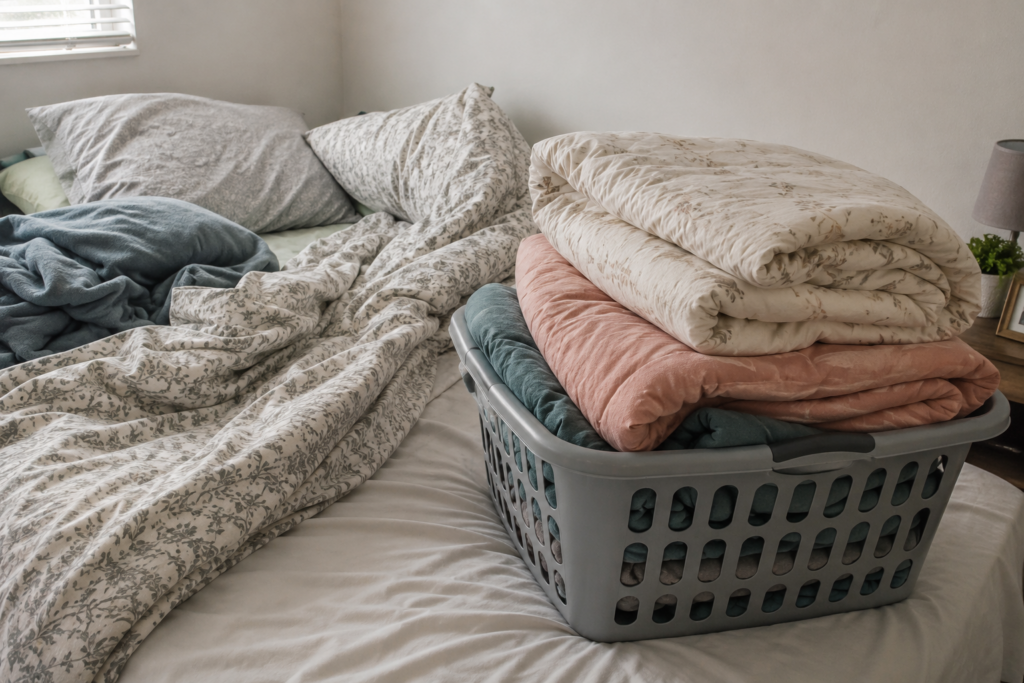
Somewhere along the way, I chose a comforter instead of duvet for our home, and if you ask me why, the honest answer is laundry. Not the pretty version of home organising where everything gets sorted into labelled boxes and your bedroom looks like a space no one sleeps in; I have written before about why that version was never going to be mine. Just the plain reality that in a full house, bedding needs to be washed often, and a duvet inner is not built for that. It is heavy enough that laundry professionals actually warn a smaller machine can strain trying to wash one, and it takes forever to dry once it is finally out. Most laundry advice agrees the insert itself only really needs washing every two to three months since the cover takes the daily wear, but if I am honest, even that would be aspirational for me. With everything else that has to get done, it was very low on my priority list. A comforter, although its cover cannot come off, is just easier to handle, and it can be put on a schedule that actually keeps up with everyday use, which is exactly why mine are on a two week rotation instead of a two-month one.
The Two Week Comforter Rotation
So a few years ago I made the swap properly, two comforters for every person in the house, and I wash them on rotation alongside everything else. It sounds like a small decision, but it helped me manage bedding altogether, because a comforter goes into the machine the same way a jersey does, no drama, no waiting three days for it to dry on the line outside. Although, on its own, a comforter is not as warm as a duvet inner, so what we do is pair it with a thick fleece blanket and a flat sheet, and everybody keeps warm even in a Cape Town winter that seems determined to get colder every year.
Building In Room For Different Kids
What makes this work for us specifically is that it flexes. My youngest sleeps under one fleece blanket, come summer or winter; she has never once asked for more. Whereas my other two are the opposite; they want three or four covers piled on top of them no matter the season, and the rotation system lets all three of them have exactly what they need without me running two completely different laundry routines. It is a bit like the household rules I never budge on, except the opposite way round; this is the one part of the house where I bend completely, because the whole point of building it myself was making sure it actually fits the people sleeping under it.
What I’ve Learned Buying From Jet Home, Pep Home and Mr Price Home
Buying comforters instead of duvets across a few years, mostly from Jet Home, Pep Home and Mr Price Home, taught me a few things I did not expect.
Jet Home
The sets around R180 to R300 are 100% polyester, and some of those have gone flimsy and lost their colour faster than I would like. But the sets priced a little higher are woven rather than just polyester, and those have held their shape properly. I didn’t know to look for that distinction the first time I bought one; I just assumed polyester was polyester, so now I check the label a little more carefully before I buy.
Pep Home
Pep sits at a similar price point to Jet Home, and the comforters there feel silkier against the skin, but they are noticeably thinner, even when the filling is technically the same as what Jet Home uses. It does not carry the same weight or depth once it is on the bed, which matters more than it sounds like it should when you are trying to keep three layers doing the work of one warm duvet. Cheap microfibre like this is always going to pill and thin out faster than cotton does; that is just how the fabric behaves, no matter which of the two stores it comes from.
Mr Price Home
Mr Price Home is the one that costs more, and I will say plainly that it costs more for a reason. The fabric feels closer to something you would find at Woolworths: sturdier, a proper weight to it, genuinely beautiful in a way the other two are not quite reaching for, and cotton like that simply holds up over the years in a way cheap microfibre cannot. It is what I would buy if the budget stretched that far every time.
I’ve learnt these same lessons about buying clothes on a budget, where the fabric content on the tag never tells you the whole story.
Which One Is Worth It
Truth is, the budget doesn’t always stretch that far, and I think that is the honest bit most posts like this skip over. Most months I am choosing between Jet and Pep instead, and living with the fact that I will probably replace those sooner, which is its own kind of cost, just one I am paying in time and repeat trips rather than upfront rand. That is not a failure of budgeting; it is just what a tight budget looks like in some months, and I would rather say that plainly than pretend that everyone can spend more upfront to save in the long run.
Three kids who want completely opposite things from the same bed, a rotation that flexes for both of them without me thinking twice about it anymore- that is really the whole test. Somewhere between buying a duvet inner because that is what you are supposed to do, and building a system that actually survives washing day after washing day, is the difference between a house that looks right and a house that works. I will take the one that works, every time.