How I Stay Organised Without Fancy Planners or Apps (And Nothing Falls Through the Cracks)
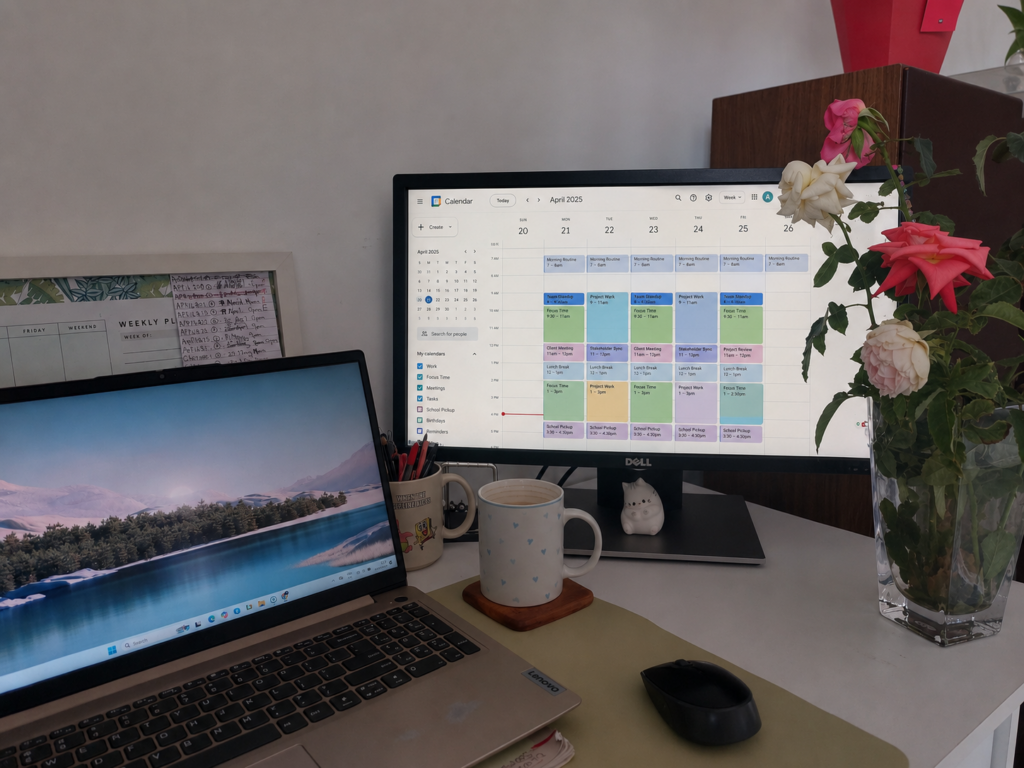
For a long time, I had no system at all. I just logged on at 9 am and started. Answering emails, responding to chats, and dealing with whatever came at me first. No structure, no plan, just winging it and hoping for the best. And I was always behind before the day had even properly started. I’m no expert on organisation tips for working moms; I had to figure it all out.
What changed everything was getting a head start. I started arriving at the office at 7:45 am, more than an hour before my work day officially begins, and that quiet time before the chaos starts is now non-negotiable for me. It’s where I set up my day, mentally prepare, and make sure that when 9 am hits, I’m already ahead, not scrambling to catch up.
My Work System — Multiple Tools, One Goal
And yes, I do use a few apps — but not in the way most productivity advice tells you to. No complicated systems, no colour-coded dashboards. Just the basics, used simply.
My starting point every morning is Google Calendar.
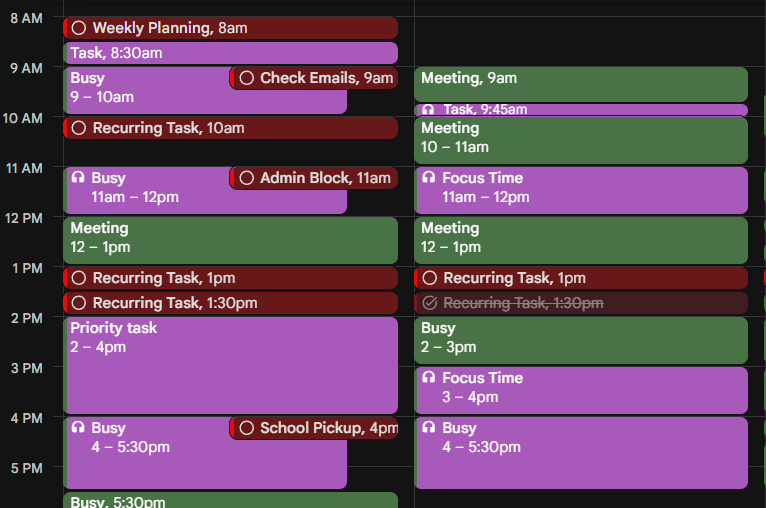
I already have recurring meetings set up weekly, and Google Tasks handles my daily recurring to-dos, so by the time I open my calendar, most of it is already populated. What I’m doing in that early morning window is filling in the gaps.
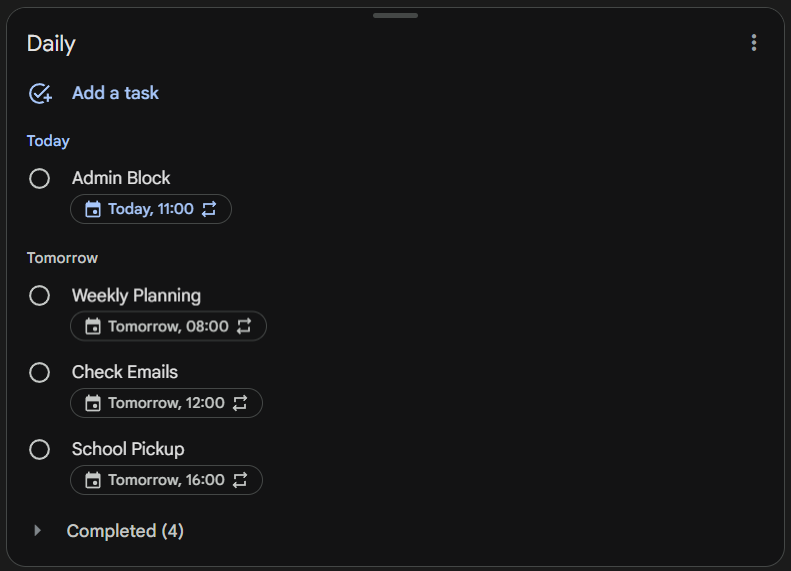
I block out focus time between my meetings, and this does two things. First, it automatically declines any meeting someone tries to set up in that space without checking with me first, because my calendar is visible to the whole organisation, which keeps me in control of my own day. Second, it removes the mental load of wondering when I have time for what. I can see exactly where I’m free, set up meetings as needed, and check availability across the team without the back-and-forth.
I also block out my school pickup time every day and make sure my team knows when I’m heading out. My status goes away, and they know not to need me during that window. No surprises, no stress.
My mailbox works on a similar principle. I don’t aim for zero emails; that’s not realistic. Instead, I organise what comes in into sections: emails that need a response today, emails I’m working on that need more time, and anything ongoing or complex. As new emails land, I sort them immediately. And even if I can’t respond fully yet, I always send a holding response. Nobody gets left without an acknowledgement. That’s non-negotiable for me.
Nobody gets left without an acknowledgement. That’s non-negotiable for me. It took me a long time to even believe I was allowed to work this way; I’ve written more about where that came from in my post on learning to set boundaries.
The Question That Changed Everything
I came across a video on TikTok by Craig Willard that said high performers are the ones getting interrupted the most. A quick question, a quick favour, a quick request for help. The person actually trying to get work done gets pecked to death by everyone else’s needs and ends up overloaded, not because of their own work, but because of everyone else’s.
That hit me because I recognised myself in it immediately.
I was spending hours on Google Chat answering questions, helping with tasks, giving advice, and saying yes to things handed to me. And while I was doing all of that, my own work was building up in the background. I was exhausted and frustrated and going in circles, not because I couldn’t manage my workload, but because I had made myself too available.
So I stopped.
I stopped dropping everything the moment someone reached out. I started responding when I had the time, not when they had the need. And the single most useful question I added to my day was this: when do you need this by?
Because nine times out of ten, it’s not right now. We just assume it is. And that assumption is what was stealing my time.
My Personal System — Loose, But It Works
When it comes to organisation tips for working moms, most advice overcomplicates it. At home I’m a lot more loose. I have a diary, but I don’t always look at it. I don’t have a colour-coded wall planner or a whiteboard covered in sticky notes. What I have is a calendar widget on my phone home screen and a Sunday habit of asking myself one simple question: what have I got coming up this week?
I’ll scroll through the school emails, because they always send the important ones on Sundays; check my calendar; and make a mental note of anything that deviates from the normal routine. An orthodontist appointment on Tuesday, a school meeting at 4h30, or whatever it is. I note it; I think about how I’ll plan my day around it. By Monday morning, I feel prepared. Not perfect. Just prepared.
The reason mental notes work for me is routine. I am a self-confessed control freak, and I’ve had to be; being a single mom for this long has made routine non-negotiable for survival. When your days follow the same basic rhythm, anything that breaks that rhythm stands out automatically. It has an impact. So it sticks.
And when I slip up, because I do, I don’t dwell. I don’t spiral. I just ask myself what can be done about it now. Reschedule? Reorganise? Move it to tomorrow? There’s always a solution, and getting stuck in what went wrong has never once helped me fix it.
If you want to see how this plays out in a real day, have a read of my working mom daily routine — it’s the same approach, just lived out hour by hour.
My Simple Organisation System for Budget Tracking
I don’t track my budget daily, and I don’t do it on any set schedule. What I do is check in when it matters most, usually in the mornings before work or just before payday when I need to see exactly where things stand.
I built my own Google Sheet. Nothing fancy, nothing complicated, just a simple spreadsheet that works for my life and my income. I record what has been paid, what is still pending, what is coming up that I haven’t accounted for yet and what I have left. Then I make sure my bank balance matches my sheet. If it doesn’t, I go through my bank statements on my app, find what I’ve missed and add it in.
That’s it. No complicated budgeting app, no envelope system, no elaborate method. Just a spreadsheet I built myself that tells me exactly where my money is at any given moment.
And if you want to try something similar without building one from scratch, I’m giving my exact Budget Sheet away as a free download to subscribers. It’s the same one I use every month. Simple, practical, and built for a real single-income life.
If you want to understand why I started taking saving seriously in the first place, I wrote honestly about that in my post on why building savings matters.
This Is What Works for Me
This is what works for me. It’s not pretty. It won’t go viral on Pinterest. But nothing falls through the cracks, and I don’t spend my days stressed about forgetting something. For a full-time working single mom managing everything alone — that’s enough. More than enough.
If you want more of this, you’re in the right place.